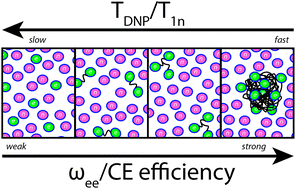
ABSTRACT: The dynamic nuclear polarization (DNP) efficiency is critically dependent on the properties of the radical, solvent, and solute constituting the sample system. In this study, we focused on the three spin e–e–n cross effect (CE)'s influence on the nuclear longitudinal relaxation time constant T1n, the build-up time constants of nuclear magnetic resonance (NMR) signal, TDNP and DNP-enhancement of NMR signal. The dipolar interaction strength between the electron spins driving the e–e–n process was systematically modulated using mono-, di-, tri-, and dendritic-nitroxide radicals, while maintaining a constant global electron spin concentration of 10 mM. Experimental results showed that an increase in electron spin clustering led to an increased electron spin depolarization, as mapped by electron double resonance (ELDOR), and a dramatically shortened T1n and TDNP time constants under static and magic angle spinning (MAS) conditions. A theoretical analysis reveals that strong e–e interactions, caused by electron spin clustering, increase the CE rate. The three spin e–e–n CE is a hitherto little recognized mechanism for shortening T1n and TDNP in solid-state NMR experiments at cryogenic temperatures, and offers a design principle to enhance the effective CE DNP enhancement per unit time. Fast CE rates will benefit DNP at liquid helium temperatures, or at higher magnetic fields and pulsed DNP, where slow e–e–n polarization transfer rate is a key bottleneck to achieving maximal DNP performance.
.svg)