National Biomedical Resource for
Advanced ESR Spectroscopy

1332349 (Funded by National Science Foundation / Emerging Frontiers in Research and Innovation)
Articles:

Short Self-Assembling Peptides Are Able to Bind to Copper and Activate Oxygen
O. V. Makhlynets, P. M. Gosavi, and I. V. Korendovych
Angew. Chem. Int. Ed. Engl. 55 (31), 9017-9020 (2016)


<doi: 10.1002/anie.201602480>
PMID: 27276534      PMCID: PMC5064842


Grants supporting this work:   1332349 (NSF / EFRI);   P41 GM103521 (NIH / NIGMS)

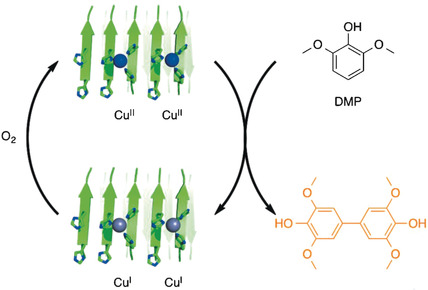
ABSTRACT:   We have shown that de novo designed peptides self-assemble in the presence of copper to create supramolecular assemblies capable of carrying out the oxidation of dimethoxyphenol in the presence of dioxygen. Formation of the supramolecular assembly, which is akin to a protein fold, is critical for productive catalysis since peptides possessing the same functional groups but lacking the ability to self-assemble do not catalyze substrate oxidation. The ease with which we have discovered robust and productive oxygen activation catalysts suggests that these prion-like assemblies might have served as intermediates in the evolution of enzymatic function and opens the path for the development of new catalyst nanomaterials.

© 2022   


Site Map

Home

About ACERT
   ACERT News
   Personnel

Contact Us
   Software Portal at Signal Science Lab
   Laboratory Service Request Portal
   To Acknowledge ACERT
 

Research
   Available Resources
   Technologies
   Research Highlights
   Collaborations

Outreach
   Dissemination
   Training/Workshops
   Publications
   Useful Links

ACERT is supported by grant 1R24GM146107 from the National Institute of General Medical Sciences (NIGMS), part of the National Institutes of Health.


National Biomedical Resource for Advanced ESR Spectroscopy

Baker Laboratory of Chemistry
259 East Ave.
Ithaca, NY 14853


National Institute of
General Medical Sciences